


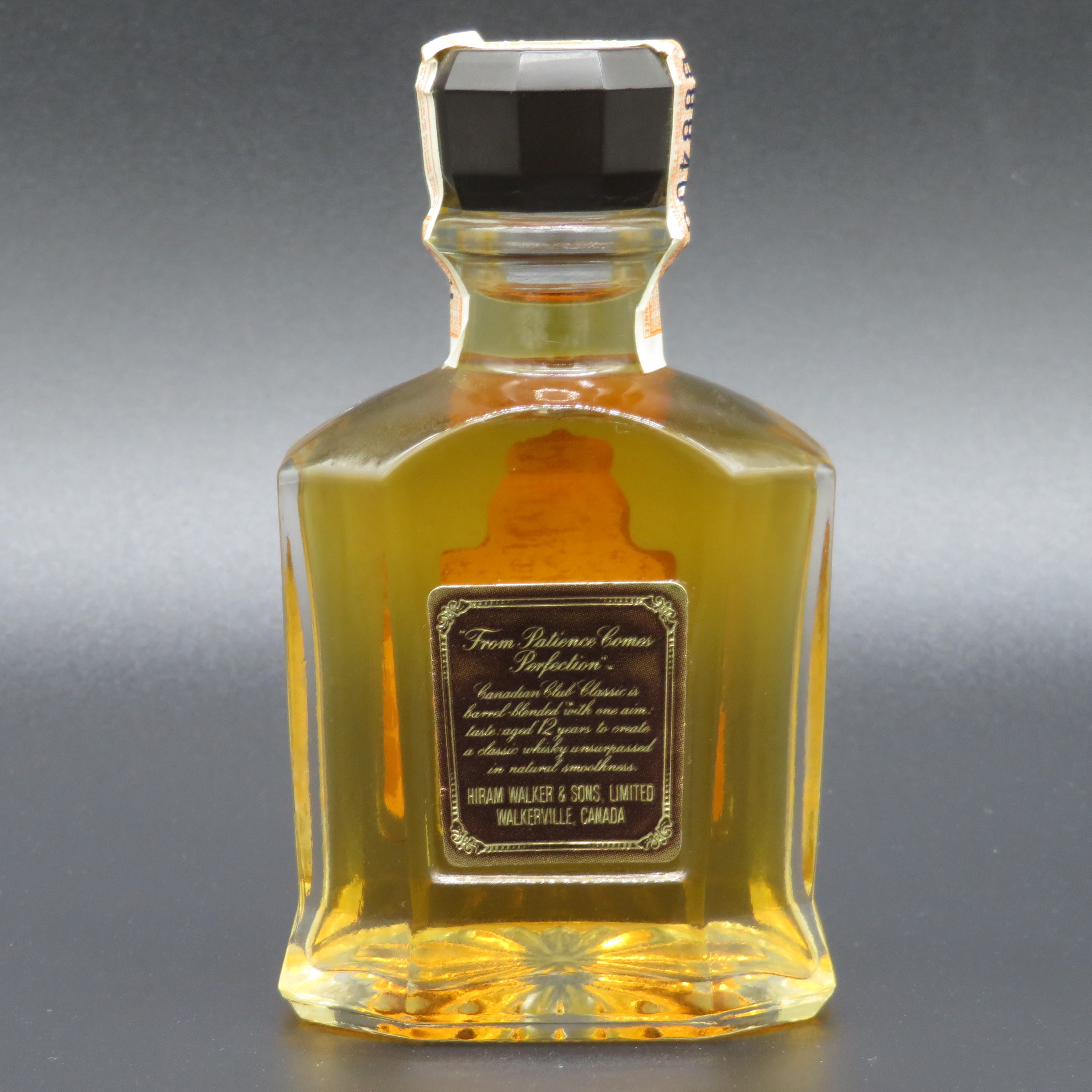


Canadian Club Classic 12 years old miniature. 1974
Canadian Club Classic 12 Year Old miniature. 1974 distilled and bottled by Hiram Walker & Sons...
Condition: Collector-Please note as this is a vintage/rare/limited edition bottle, conditions of bottle/label and liquid level can vary - Some years can vary and as estimations only (example: estimated 1970s/80s).
Fill level: In the neck.
Whisky still produced: Yes.
Category: Blend.
Distillery: Still producing.
Bottler: Distillery Bottling.
Bottling series: Miniature.
Bottling Year: 1974. The Canadian tax strip reads 1974. This indicates that the youngest whisky in the bottle was distilled in 1974.
Stated Age: 12 years old.
Cask type: Not stated.
Strength: 40.0 % Vol.
Size: 50 ml.
Colouring: Unknown.
Chill-filtered: Unknown.
Bottle code: B8849598 Canada tax code.
Country Origin: Canada.
Market: Worldwide.
Review 92 points;
Here's a real treat - a mini of Canadian Club Classic 12 Year Old from 1974! I love the old Canadian whiskies - they tend to be more rye forward, with more complexity and less overt caramel. I've tasted some Crown Royal from the 1970s, and a Harwood from the 1940s - both fantastic.
Tasting notes;
Appearance/colour; Golden, with orange highlights.
Nose; Loaded with butterscotch, dark honey and marzipan. Seems quite sweet, as you can imagine, but there is definitely a herbaceous rye providing a backbone. Reminds me of a rum-soaked Christmas cake - very fruity. With water, shyer and a little more herbal.n intoxicating burst of maraschino cherry, ripe bramble and dark chocolate mint with hints of orange bitters and walnut liqueur.
Palate; Wonderful balance between lighter caramel and honey with the sharper rye grain. Luxurious mouthfeel. Cinnamon and cloves, and definite oak. Light maple syrup - very light. Livelier with water. Very complex interplay of flavours and absolutely delicious.
Finish: Long, again with the honey but spicier and chalkier (in a good way) with thick oak. I mentioned this in a prior review, but some years ago I blind tasted the previous bottling of CC 12 (not the current bottling) and mistook it for a rum (I would have been mortified, but most of the rest of the class made the same mistake - we tasted it right after the Laphroaig Quarter Cask!) This 1974 CC 12 has a similar profile on the nose, but if memory serves is much drier on the palate, which is terrific. Like so many older Canadian whiskies, this has more complexity than current bottlings.
Distillery History:
Origins and Early Ambition (1850s–1880s)
Hiram Walker, a Detroit businessman with a sharp eye for opportunity, crossed the river into Canada in the 1850s and purchased land in what would become Windsor, Ontario. By 1858, he had built a distillery that was far ahead of its time — a fully integrated operation with its own grain supply, cooperage, and aging warehouses. Walker believed whisky should be matured in oak, bottled with a consistent identity, and sold under a recognisable brand. These ideas were radical in an era when most producers sold raw spirit in bulk.
His insistence on quality and consistency quickly set his whisky apart. The distillery’s location offered easy access to Great Lakes shipping routes, abundant freshwater, and proximity to U.S. markets, giving Walker a logistical advantage few competitors could match.
Walkerville: The Company Town
Rather than simply building a factory, Walker created an entire community around his distillery. The settlement became known as Walkerville, a model industrial town with housing, utilities, shops, and civic buildings funded by the Walker family. Workers lived steps away from the distillery, and the town developed its own identity, eventually becoming part of Windsor.
Walker himself remained a U.S. resident, commuting daily across the river — a symbol of the cross‑border nature of his business.
Shaping Canadian Whisky Standards
Hiram Walker & Sons played a decisive role in defining what Canadian whisky would become. The distillery adopted continuous distillation early, allowing for cleaner grain whisky production. Walker also championed barrel aging, helping influence the regulatory framework that later required Canadian whisky to be matured for a minimum period.
Another key innovation was Walker’s approach to blending: a light, corn‑based whisky combined with rye “flavouring whisky,” a style that would become the hallmark of Canadian whisky. He also pushed for bottled sales rather than bulk shipments, improving quality control and brand recognition.
Prohibition, Consolidation, and Expansion (1920s–1940s)
The Walker family controlled the business until 1926, when entrepreneur Harry C. Hatch acquired it. Hatch already owned Gooderham & Worts, and he merged the two operations into a powerful distilling group. During U.S. Prohibition, Hiram Walker & Sons continued producing legal Canadian spirits, which were frequently smuggled into the United States by independent bootleggers.
In 1935, the company expanded again by taking a controlling interest in H. Corby Distillery, strengthening its influence over Canadian whisky production and distribution.
Postwar Growth and Global Reach (1950s–1980s)
By the mid‑20th century, Hiram Walker & Sons had become one of the largest distillers in North America. Its brands — especially Canadian Club — achieved global recognition. The distillery’s scale, technical sophistication, and access to international shipping routes allowed it to dominate export markets.
In 1987, the company was purchased by Allied Lyons, marking the end of its era as an independent Canadian powerhouse.
Modern Ownership and Operations (2005–present)
The next major shift came in 2005, when Pernod Ricard acquired Allied Domecq. Today, Hiram Walker & Sons operates under the management of Corby Spirit and Wine, producing a wide portfolio of Canadian whiskies and spirits.
The Windsor site is now:
-
North America’s largest beverage‑alcohol distillery,
-
Home to over a million aging barrels,
-
Equipped with multiple column stills, pot stills, and a modern experimental distillery,
-
A central hub for Canadian whisky innovation led by master blender Dr. Don Livermore.
The facility remains one of the oldest continuously operating distilleries on the continent.
Enduring Legacy
Hiram Walker & Sons shaped Canadian whisky through its:
-
pioneering production methods,
-
influence on national regulations,
-
early adoption of branding and bottling,
-
cross‑border commercial strategy,
-
creation of Walkerville,
-
and stewardship of iconic brands like Canadian Club.
© copyright, Tasting World Ltd. England.